Site input review
We structure roadway width, setback, mounting height, pole spacing, orientation and required operating hours before product selection begins.
Application engineering
Outdoor schemes succeed when pole geometry, photometry, electrical architecture and operating profile are coordinated early.

We structure roadway width, setback, mounting height, pole spacing, orientation and required operating hours before product selection begins.
IES or LDT distributions are checked against target illuminance, uniformity, spill-light boundaries and visual comfort priorities.
Load, control behavior, surge exposure, ingress protection and maintainable component access are considered as a complete system.
Schedules, calculation context and product-family records are organized for design review, procurement comparison and handover.
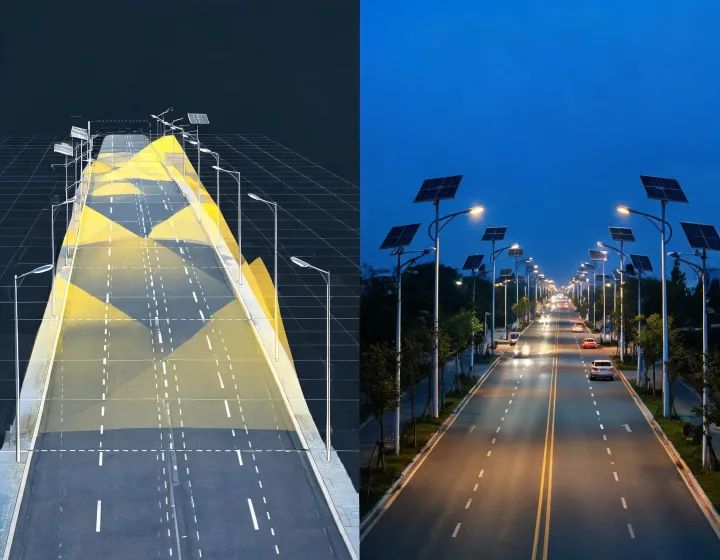
Roadway case workflow
A road corridor assessment compared several distributions at the same mounting height instead of choosing on maximum lumen output. The team reviewed minimum-to-average uniformity, pedestrian-edge visibility and likely dirt depreciation. That evidence made the spacing discussion measurable and prevented a high-output optic from creating excessive bright-dark contrast.
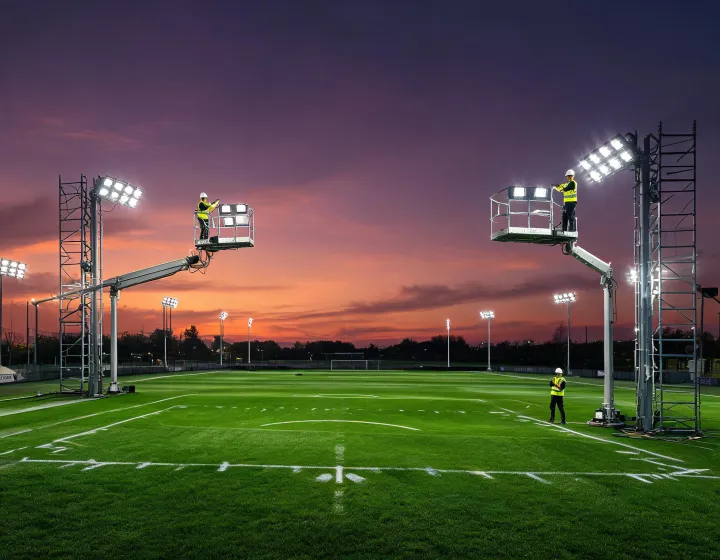
Sports ground workflow
For a community pitch, floodlight positions were divided into aiming groups with explicit target areas. Calculation sheets recorded horizontal illuminance, edge coverage and upward-light considerations. The installation team received a repeatable focusing sequence, reducing subjective nighttime adjustments and giving the operator a clear basis for later maintenance checks.
Our specification team can work from plans, coordinates, pole schedules or a concise site brief.