Specification desk: IES/LDT and application supportAccess files

IES/LDT · distributions · specification context

Fonroche Photometric Resources

Find the optical and technical evidence needed to model outdoor lighting families with fewer assumptions.
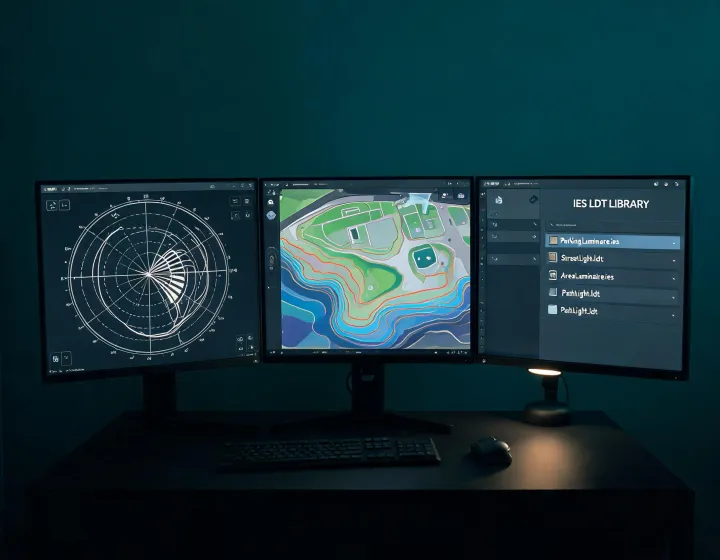
Photometric file resource workstation

Filter by the decision you need to make

Resource packages are organized around file format, application and luminaire configuration. Confirm the exact product code, optic, CCT and drive condition before using a file in a calculation.

FORMAT

IES files

North American photometric exchange for calculation platforms and project submittals.

FORMAT

LDT files

EULUMDAT distribution data for compatible European lighting design workflows.

APPLICATION

Roadway optics

Longitudinal distributions for road width, setback and spacing comparisons.

APPLICATION

Area and sports optics

Broad, asymmetric and flood distributions for sites with defined aiming or boundary criteria.

What to verify before importing a file

Luminaire configuration
Product family, optic code, CCT and drive current must match the proposed schedule.
Measurement basis
LM-79 context should identify the tested state behind luminous flux and intensity distribution.
Coordinate orientation
C-plane or Type C orientation must align with the luminaire position in the model.
Maintenance inputs
Lumen depreciation, dirt and environmental assumptions belong in the project model, not the source file.
Control behavior
Dimming profiles affect energy use and operating levels but do not change the static photometric distribution.
Compliance scope
A calculation supports design review; the governing authority decides the applicable criteria and acceptance process.

Photometric file questions

No. Use a file tied to the proposed optical configuration and operating condition. Similar housings can contain materially different distributions.

Geometry, aiming, supply condition, surface reflectance, obstructions, dirt and instrument practice can all affect comparison. Record these variables before drawing a conclusion.

No. Efficacy describes output per input power. Distribution, glare, uniformity, spectrum and the visual task determine whether that output is useful.

Request the exact file set for your schedule

Include product family, optic, CCT, control requirement and application.

Request Photometric Data